Module 1

Daily profit foundations

10 lessons, 45 stepsOne instruction at a time, each with the result to expect. Tick steps as you go; Helix remembers.

Outcome: every morning you know if yesterday made money. You also know the few numbers that guide every other choice in this course.

Time: 60 to 90 minutes to set up once, then 2 minutes a day. Related SOPs: 02 Scorecard, 03 Constraint diagnosis

In plain words

Stage: Grow (keep more of every sale, then scale). Every lesson below is tagged with its stage; see Attract, Convert, Grow.

What it is: Each morning you check one number: did yesterday make a profit?

Why it matters: Sales can go up while you lose money. Profit is what pays you, so every other choice starts here.

Do this:

  1. Write down your costs once: product cost, shipping, payment fees and monthly bills.
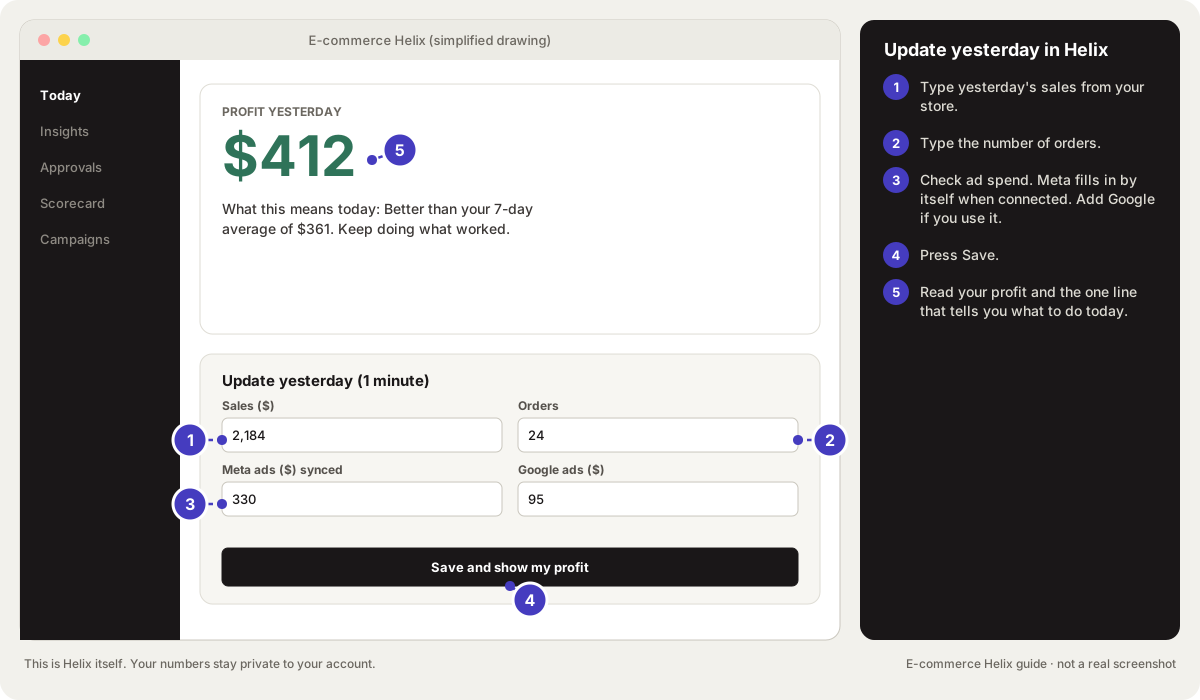
  2. Each morning, type yesterday's sales, orders and ad spend into Helix (2 minutes).
  3. Read the profit number and the one line that tells you what to do today.

Words to know:

  • Profit: Usually means contribution profit: what is left from sales after product cost, shipping, payment fees, discounts, refunds and ads. Net profit also takes off fixed costs.
  • Revenue: The money customers paid for orders. Helix uses net sales: after discounts and refunds, without GST or VAT. It is not what you keep.
  • Break-even ROAS: The ROAS where an order makes $0 profit after its costs. Below it, ads lose money.
  • MER: Helix shows it as all ad spend divided by all sales, as a percentage. MER 25% means $25 of ads for every $100 of sales. Many tools flip it to sales divided by ad spend, so 25% shows as 4x.

All words are explained in the glossary.

Lesson 1.1: Why revenue is the wrong scoreboardGrow

In short

Revenue (all the money customers paid you) feels like success.

Do this now

Step 1: Find last month's sales in your store.

Why this matters

Revenue (all the money customers paid you) feels like success. But it does not tell you what you kept. A $5,000 day can still lose money once you pay for ads, products and shipping. Ad platforms also each claim the same sale, so their totals add up to more sales than you really had. This lesson gets you a real starting point so you can see the gap for yourself.

Step 1 of 40 of 4 done

Find last month's sales in your store.

  1. In Shopify, click Analytics, then Reports.
  2. Click Total sales over time.
  3. Set the date at the top to Last month.
  4. Write down the Net sales number (sales after discounts and refunds).

Expected result

You have one dollar figure for last month's net sales written in a note or on paper.

Watch out

Use the figure without GST, VAT or sales tax. That tax belongs to the government, not to you. Shopify's Net sales already leaves tax out.

Tips

GST
Goods and services tax. Each country sets its own rate, such as 10% (Australia) or 15% (New Zealand). Registered businesses add it to most sales.
VAT
Value added tax: the UK and EU version of GST, usually included in the shown price.
Sales tax
In the US, a tax set by most states (and many local areas) that the seller collects at checkout.

Lesson 1.2: Your cost driversGrow

In short

Cost drivers are your average costs, and they are what turn sales into profit .

Do this now

Step 1: Work out your product cost % .

Why this matters

Cost drivers are your average costs, and they are what turn sales into profit. Get them roughly right once and every profit number in Helix becomes trustworthy. You set them up in about 30 minutes and check them every 3 months.

Step 1 of 60 of 6 done

Work out your product cost %. If your plan has it, use Analytics > Reports > Gross profit by product (fill in "Cost per item" first). Or take your top 10 sellers. Divide each one's landed cost (price paid plus freight and duty) by its selling price.

Expected result

You have one percentage. For many online stores it sits somewhere between 20% and 40%.

Watch out

Use prices without GST, VAT or sales tax. Include freight and duty, not just the factory price.

Tips

Product cost
What one item costs you to make or buy, including freight to your warehouse.
Profit
Usually means contribution profit: what is left from sales after product cost, shipping, payment fees, discounts, refunds and ads. Net profit also takes off fixed costs.
Landed cost
What one unit really costs once it reaches your warehouse: product, freight, duties and fees.
GST
Goods and services tax. Each country sets its own rate, such as 10% (Australia) or 15% (New Zealand). Registered businesses add it to most sales.
VAT
Value added tax: the UK and EU version of GST, usually included in the shown price.
Sales tax
In the US, a tax set by most states (and many local areas) that the seller collects at checkout.

Good to know

Variable costs: they grow with every order:

Cost How to work it out
Product cost % What one item costs to land in your warehouse (the product, plus freight to you, plus import duties), divided by its selling price. Average it across what you sell. If your sales mix changes a lot, weight it by units sold in the last 90 days.
Fulfilment and shipping per order What your warehouse or 3PL (a company that packs and ships for you) charges to pick and pack, plus postage. Take away what customers pay you for shipping.
Packaging per order Box or mailer, tissue paper, inserts.
Payment fees What Shopify Payments and any other payment provider charge. If you do not know, use 2.6%. Your payment reports show the real figure.
Other per-order costs Marketplace commission, a free gift with each order, shipping protection you pay for, buy now pay later fees.

Common questions

  1. Is my own wage a cost? Yes. Put a fair wage for yourself into fixed costs, even if you do not pay it yet. If you leave it out, the business will look healthier than it is.
  2. Do I include GST, VAT or sales tax? No. Use sales and costs without the tax you collect and pass on to the government.
  3. How do I handle returns? Use sales after refunds (net revenue). If you get lots of returns, add a returns cost per order. That is the return postage plus any stock you have to throw away.
  4. What about tariffs and duties on orders sent overseas? Add them as a per-order cost for that country. Or keep a separate scorecard for each country.
  5. I make my products myself. Your product cost % includes materials and the labour for each unit. Production staff on a salary go in fixed costs.
  6. I sell wholesale and retail. Keep online retail separate. Give wholesale a fair share of the fixed costs.
  7. My costs will change soon. Save each version of your costs with a start date. That keeps your past numbers accurate.
  8. I cannot get an exact average product cost. Start with a sensible estimate from your top 10 sellers. A rough number you use every day beats a perfect number you never use.
  9. What happens to product cost during a sale? Product cost % goes up when you give a discount. The price drops, but the cost stays the same. Use a separate cost setting for sale periods.
  10. I have several stores or regions. Keep one scorecard per store or currency, then look at them combined.

Lesson 1.3: The daily scorecardGrow

In short

The scorecard is a short daily record of the numbers that decide profit .

Do this now

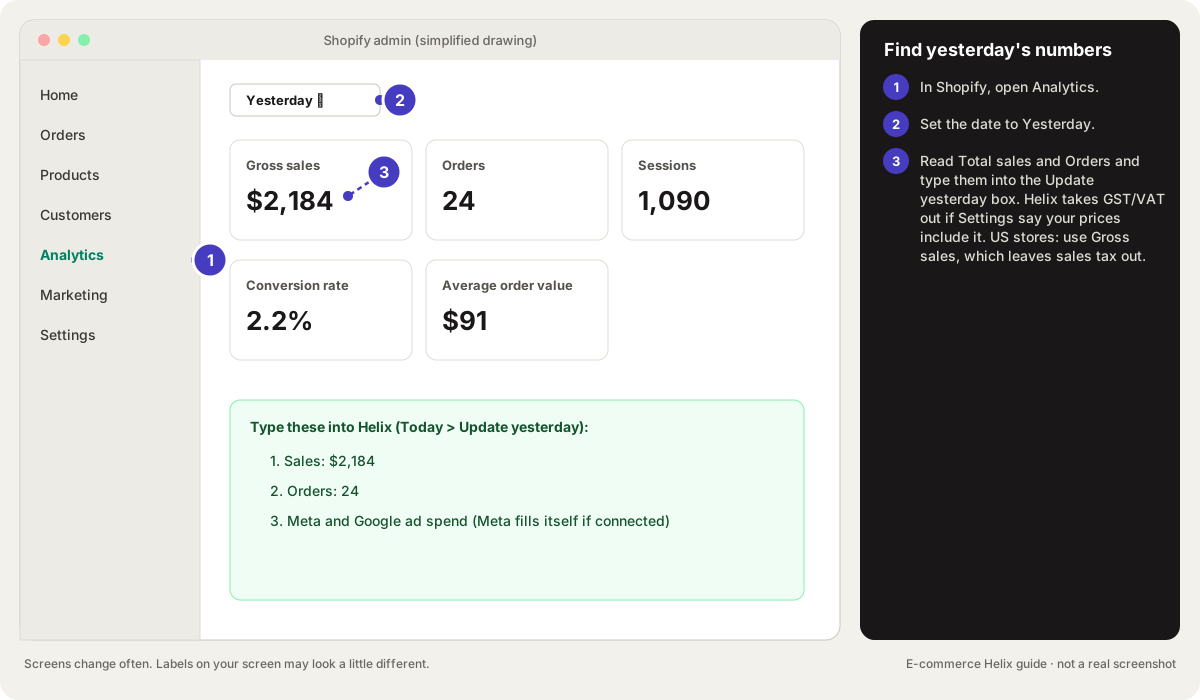
Step 1: Each morning, open Shopify Analytics and set the date to Yesterday .

Why this matters

The scorecard is a short daily record of the numbers that decide profit. In Helix it lives in Your numbers, and the quick version is the profit box on Today. You type in a handful of numbers and Helix works out the rest, so you never do the maths yourself.

Step 1 of 40 of 4 done

Each morning, open Shopify Analytics and set the date to Yesterday. Note Gross sales, Orders, Discounts, Returns and Sessions (a session is one visit to your store).

Expected result

You have five numbers for yesterday, taking under a minute.

Tips

Session
One visit to your store. One person can make several visits.

Good to know

Helix then works out the rest for you:

Number What it means How it is worked out
Variable costs Costs that came with yesterday's orders Revenue x product cost % + orders x per-order costs + revenue x payment fee %
Contribution profit What is left after order costs and ads Revenue - variable costs - ad spend
Net profit (estimate) What the business really earned Contribution profit - one day's share of fixed costs
MER % How much of your sales went on ads Ad spend ÷ revenue
VCR How much of your sales went on order costs Variable costs ÷ revenue
FCR How much of your sales went on fixed bills Fixed costs ÷ revenue
RPV How much each visit is worth Revenue ÷ sessions
Conversion rate How many visits turn into orders Orders ÷ sessions
AOV Average order value Revenue ÷ orders
Cost per visit What ads paid for each visit Ad spend ÷ sessions
Blended CAC What ads paid for each new customer Ad spend ÷ orders from new customers

Find yesterday's numbers in Shopify

Drawing, not a real screenshot. Labels on your screen may look a little different. Official help: Shopify: reports and analytics

Update yesterday in Helix

Drawing, not a real screenshot. Labels on your screen may look a little different.

Lesson 1.4: Healthy rangesGrow

In short

A number on its own means little until you know whether it is healthy.

Do this now

Step 1: Open Dashboard in Helix and pick Month so you are looking at the last 30 days.

Why this matters

A number on its own means little until you know whether it is healthy. These ranges tell you at a glance what is fine, what to watch and what needs action. Helix colours each one green, amber or red for you.

Step 1 of 40 of 4 done

Open Dashboard in Helix and pick Month so you are looking at the last 30 days.

Expected result

You see metric cards with a coloured dot on each.

Good to know

Number Healthy (a common guide) Warning sign
Net profit 10 to 20% of sales Below 5%
MER % (ads as a share of sales) 20 to 35%. It falls as more customers come back and buy again. Above 45%
VCR (order costs as a share of sales) 30 to 45% Above 50%. Above 60% makes growing with ads very hard.
FCR (fixed bills as a share of sales) 10 to 20% Above 30%

Lesson 1.5: Your target MER and break-even numbersGrow

In short

These numbers tell you how much you can spend on ads and still make money.

Do this now

Step 1: Work out your target MER : 100% minus VCR, minus FCR, minus the profit % you want.

Why this matters

These numbers tell you how much you can spend on ads and still make money. They are the line you should not cross with any ad choice. Once Helix knows your costs, it works them out for you. Doing it by hand once helps you trust them.

Step 1 of 50 of 5 done

Work out your target MER: 100% minus VCR, minus FCR, minus the profit % you want. FCR is your fixed costs divided by net sales. Example: 100 - 40 - 15 - 15 = 30%.

Expected result

You have a target MER, for example 30%. That means you can spend $30 on ads for every $100 of sales, across new and returning customers.

Tips

MER
Helix shows it as all ad spend divided by all sales, as a percentage. MER 25% means $25 of ads for every $100 of sales. Many tools flip it to sales divided by ad spend, so 25% shows as 4x.
Profit
Usually means contribution profit: what is left from sales after product cost, shipping, payment fees, discounts, refunds and ads. Net profit also takes off fixed costs.
Fixed costs
Bills that stay the same each month, like rent, software, staff and your own wage.

Lesson 1.6: A 2-minute morning routineGrow

In short

Two minutes each morning stops small problems from becoming expensive ones.

Do this now

Step 1: Open Today in Helix and read the Profit yesterday number and the sentence under it.

Why this matters

Two minutes each morning stops small problems from becoming expensive ones. You read one number, choose how hard to push today, and check nothing is broken. Over weeks, the decision log becomes your best teacher.

Step 1 of 40 of 4 done

Open Today in Helix and read the Profit yesterday number and the sentence under it.

Expected result

You know if yesterday made money and how it compares with your 7-day average.

Tips

Profit
Usually means contribution profit: what is left from sales after product cost, shipping, payment fees, discounts, refunds and ads. Net profit also takes off fixed costs.

Lesson 1.7: Sales, costs and profit in plain EnglishGrow

In short

Most new owners look at sales and feel rich, then wonder where the money went.

Do this now

Step 1: Write down one product and its price.

Why this matters

Most new owners look at sales and feel rich, then wonder where the money went. Sales is not what you keep. Once you can see every layer that comes off a sale, you know which lever to pull.

Step 1 of 20 of 2 done

Write down one product and its price. Next to it, write a cost for each of the seven layers in this lesson. Guess if you have to. The layers are product, freight and duty, payment fees, packaging, shipping, marketing and fixed costs.

Expected result

You have a rough cost for every layer of one order.

Tips

Fixed costs
Bills that stay the same each month, like rent, software, staff and your own wage.

Good to know

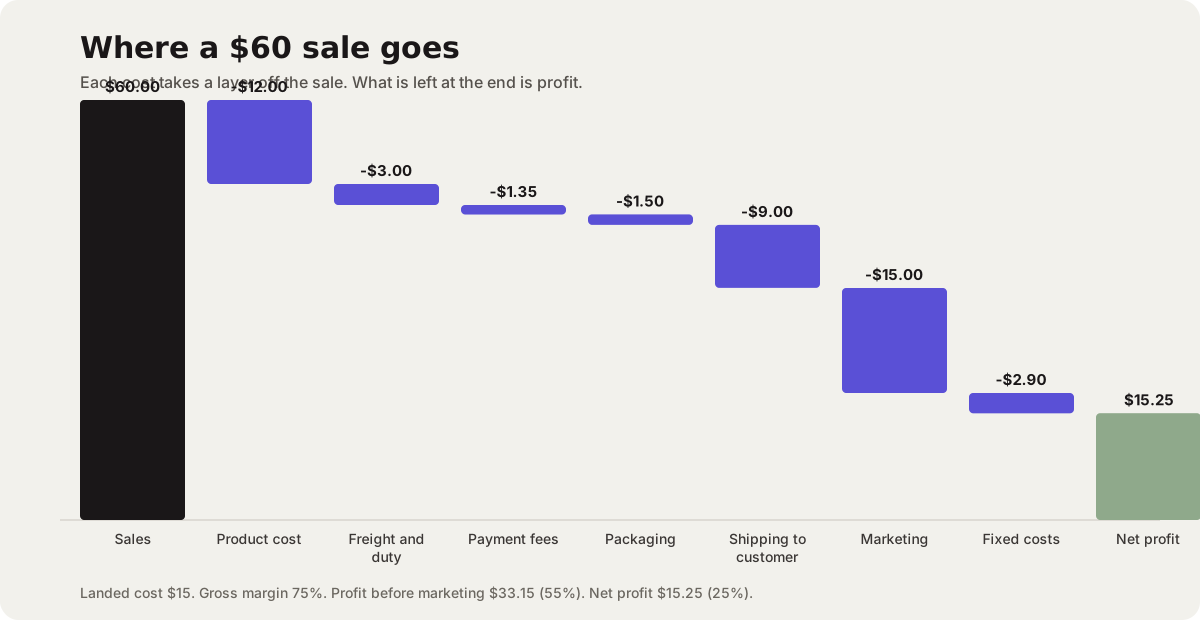
Worked example: a $60 product made overseas. It costs $12 to make and $3 to ship in with duty. So the landed cost is $15 and you keep 75% after product cost. Payment fees take about $1.35, packaging $1.50 and postage $9, leaving $33.15 before marketing. Ads cost $15 per order, leaving $18.15. Shopify, apps and other bills of $580 a month over 200 orders is $2.90 an order. Net profit is $15.25 an order (25%), or about $3,050 a month. If ads crept up to $33 an order, every sale would lose money once bills are counted. Sales would look the same.

Where a $60 sale goes

  1. Product cost (COGS): making or buying the item.
  2. Freight and duty: getting it from the factory to you. Product cost plus freight and duty is your landed cost. Sales minus landed cost is gross profit, and as a share of sales it is gross margin.
  3. Payment fees: what Shopify Payments, other payment providers or buy now pay later keep. On Shopify's Basic plan, Australian stores pay 1.7% plus 30 cents on local cards. US stores pay 2.9% plus 30 cents. Overseas cards and other plans differ (see Shopify: AU pricing and Shopify: US pricing).
  4. Packaging: mailer, box, tissue and inserts.
  5. Shipping to the customer: the postage you pay. What is left now is profit before marketing, the money one order leaves to pay for ads and bills.
  6. Marketing: ads and other marketing. What is left now is contribution.
  7. Fixed costs: Shopify and app subscriptions, wages, rent and software, spread over your orders. What is left is net profit.

Sales (also called revenue) is what customers pay you. In Helix it is shown without GST, VAT or sales tax, because that money belongs to the tax office. From there, each cost takes a layer off:

Lesson 1.8: Set up your profit dashboardGrow

In short

Every number Helix shows you later depends on knowing your costs.

Do this now

Step 1: Enter the costs of one typical order in Profit setup .

Why this matters

Every number Helix shows you later depends on knowing your costs. That includes yesterday's profit, break-even and how much you can spend on ads. Five minutes here makes every other screen honest.

Step 1 of 30 of 3 done

Enter the costs of one typical order in Profit setup.

  1. Open Profit in Helix.
  2. Pick your best seller (or an average order if you sell many products).
  3. Type its selling price.
  4. Type each cost: product, freight and duty, packaging, shipping to the customer, payment fees.

Expected result

The waterfall on the right shows your profit per order and your break-even numbers.

Tips

Profit
Usually means contribution profit: what is left from sales after product cost, shipping, payment fees, discounts, refunds and ads. Net profit also takes off fixed costs.

Lesson 1.9: How much to spend on marketingGrow

In short

Spend too little and the store never grows.

Do this now

Step 1: Open Profit setup and read your break-even MER , break-even ROAS and break-even cost per purchase .

Why this matters

Spend too little and the store never grows. Spend too much and every sale loses money. A share of sales gives you a sense check, and your own margin tells you the hard limit.

Step 1 of 30 of 3 done

Open Profit setup and read your break-even MER, break-even ROAS and break-even cost per purchase.

Expected result

You know the marketing share at which you stop making money.

Tips

Profit
Usually means contribution profit: what is left from sales after product cost, shipping, payment fees, discounts, refunds and ads. Net profit also takes off fixed costs.
MER
Helix shows it as all ad spend divided by all sales, as a percentage. MER 25% means $25 of ads for every $100 of sales. Many tools flip it to sales divided by ad spend, so 25% shows as 4x.
Break-even ROAS
The ROAS where an order makes $0 profit after its costs. Below it, ads lose money.
ROAS
Return on ad spend: how many dollars of sales you get for each $1 of ads. ROAS 3 means $3 of sales for $1 of ads.
CPA
Cost per acquisition: how much ad money it took to get one sale.

Good to know

High margin products can afford a higher share; low margin products cannot. Always leave room between your marketing share and your break-even for fixed costs and profit.

  • Before your first sales or under about $5,000 a month: a percentage target means little yet. Set a small test budget you can afford to lose, like $20 to $50 a day for two weeks. Judge each test by its cost per purchase against your break-even cost per purchase.
  • Growing (about $5,000 to $80,000 a month): total marketing is often about 10% to 30% of sales. It depends on your margin and how far along you are. Newer brands buying growth sit near the top; brands with lots of returning customers sit lower.
  • Scaling (over about $80,000 a month): many brands sit around 15% to 25% of sales on all marketing. Spending more is fine while your contribution margin stays above zero and returning customers grow. Those customers pay back the cost of winning them.

Guides by stage (guides, not rules):

Your hard limit comes from your margin, not from a rule. Take profit before marketing as a share of sales. That is your break-even MER: marketing at that share of sales leaves exactly zero. Break-even ROAS is 1 divided by it. In the $60 example, profit before marketing is $33.15, so break-even MER is 55% and break-even ROAS is 1.81. Your break-even cost per purchase (break-even CPA, as in Lesson 1.5) is the same $33.15. If you pay more than that in ads to win one order, you lose money on it.

Example

A candle store had this day:

  • Revenue $1,800, 30 orders, 900 sessions, $520 ad spend.
  • Product cost 28%. Fulfilment $9 per order. Packaging $1.20 per order. Payment fees 2.6%.
  • Fixed costs $9,000 a month.

Working it out step by step:

  1. Variable costs = 1,800 x 0.306 (product cost + fees) + 30 x $10.20 (shipping + packing). That is $551 + $306 = $857. That is 48% of sales (VCR 48%).
  2. Contribution profit = 1,800 - 857 - 520 = $423.
  3. Fixed costs per day = $9,000 ÷ 30.4 = $296. Net profit is about $127, or 7% of sales.
  4. MER = 520 ÷ 1,800 = 29%. RPV = $2.00 per visit. AOV = $60.

What it shows: MER (ads) looks fine. The real squeeze is VCR at 48%. Shipping costs $9 on a $60 order, which is 15% of every sale. The fix is cheaper shipping and bigger orders, not ads.

Lesson 1.10: Track your numbers in a spreadsheetGrow

In short

Writing your numbers down every day is how you see trouble early.

Do this now

Step 1: Download the Helix tracking sheet.

Why this matters

Writing your numbers down every day is how you see trouble early. A simple sheet does the maths for you, so you only type what happened.

Step 1 of 100 of 10 done

Download the Helix tracking sheet.

  1. Open the sheet download.
  2. Save it somewhere you can find it, like your Desktop.

Expected result

You have a file called helix-metrics-tracker.xlsx.

Self-check

  1. Why are the sales numbers inside ad platforms a poor scoreboard?
  2. Where does a founder's wage go?
  3. VCR is 45%, FCR is 20% and you want 10% profit. What is your target MER?
  4. AOV is $80 and VCR is 40%. What is break-even CPA?
  5. MER is on target but profit is thin. Which number do you check next?
Answers
  1. Each platform counts the same sale and uses its own rules for what counts. Your bank account only counts each sale once.
  2. In fixed costs.
  3. 100 - 45 - 20 - 10 = 25%.
  4. 80 x 0.6 = $48.
  5. VCR (order costs), then FCR (fixed bills).

Words to know in this module

Profit
Usually means contribution profit: what is left from sales after product cost, shipping, payment fees, discounts, refunds and ads. Net profit also takes off fixed costs.
Product cost
What one item costs you to make or buy, including freight to your warehouse.
Fixed costs
Bills that stay the same each month, like rent, software, staff and your own wage.
Revenue
The money customers paid for orders. Helix uses net sales: after discounts and refunds, without GST or VAT. It is not what you keep.
GST
Goods and services tax. Each country sets its own rate, such as 10% (Australia) or 15% (New Zealand). Registered businesses add it to most sales.
VAT
Value added tax: the UK and EU version of GST, usually included in the shown price.
Break-even ROAS
The ROAS where an order makes $0 profit after its costs. Below it, ads lose money.
ROAS
Return on ad spend: how many dollars of sales you get for each $1 of ads. ROAS 3 means $3 of sales for $1 of ads.
MER
Helix shows it as all ad spend divided by all sales, as a percentage. MER 25% means $25 of ads for every $100 of sales. Many tools flip it to sales divided by ad spend, so 25% shows as 4x.
Sales tax
In the US, a tax set by most states (and many local areas) that the seller collects at checkout.
Landed cost
What one unit really costs once it reaches your warehouse: product, freight, duties and fees.
Buy now pay later
Payment options that let shoppers split the cost into smaller payments.
Variable costs
Costs that grow with every order: product cost, shipping and payment fees.
3PL
Third-party logistics: a warehouse company that stores your stock and packs and ships your orders.
All words to know