Module 9

Your store: more sales per visit and bigger orders

18 lessons, 78 stepsOne instruction at a time, each with the result to expect. Tick steps as you go; Helix remembers.

Outcome: a store that turns more visits into sales. It is clear, convincing, easy to buy from, and good at making orders bigger.

Related SOPs: 01 Store audit, 11 Landing pages and CRO, 12 AOV and cart offers

In plain words

Stage: Convert (turn visits into sales). Every lesson below is tagged with its stage; see Attract, Convert, Grow.

What it is: How to turn more of your visitors into buyers, and get bigger orders.

Why it matters: If more visitors buy, every ad dollar goes further without spending more.

Do this:

  1. Make the top of each product page clear: what it is, price, reviews, add to cart.
  2. Remove anything that slows checkout and turn on express payment buttons.
  3. Set a free shipping amount a bit above your average order (about 1.25 times).

Words to know:

  • Conversion rate: Out of every 100 visits, how many end in an order. 2% means 2 orders per 100 visits.
  • Above the fold: The part of a page you see before you scroll.
  • Free shipping threshold: The order amount where shipping becomes free, like 'Free shipping over $100'.
  • AOV: Average order value: total sales divided by number of orders.

All words are explained in the glossary.

Lesson 9.1: The improvement systemConvert

In short

CRO ( conversion rate optimisation) means getting more of your visitors to buy.

Do this now

Step 1: Score each key page against the checklists in Lesson 9.2 and list every gap.

Why this matters

CRO (conversion rate optimisation) means getting more of your visitors to buy. A simple monthly loop beats random changes, because each fix is chosen for its likely payoff and then measured.

Step 1 of 50 of 5 done

Score each key page against the checklists in Lesson 9.2 and list every gap.

Expected result

You have a list of missing items per page.

Tips

Lesson 9.2: Page checklistsConvert

In short

Each page type has a short list of things shoppers expect.

Do this now

Step 1: Check the top of your home page on your phone, before you scroll.

Why this matters

Each page type has a short list of things shoppers expect. Missing items cost sales quietly. Above the fold means what people see before they scroll. On a phone that space is tiny, so it must work hard.

Step 1 of 60 of 6 done

Check the top of your home page on your phone, before you scroll. You want a promo bar ("Free shipping over $80") and a simple menu. Add a banner with one message and its own phone image. Add one clear button and a trust sign (star rating, customer count or press logo).

Expected result

All five items are visible without scrolling on a phone.

Lesson 9.3: Accessibility basicsConvert

In short

Accessibility means everyone can use your store.

Do this now

Step 1: Run your text and button colours through a free online contrast checker.

Why this matters

Accessibility means everyone can use your store. That includes people who cannot see well or who use a keyboard instead of a mouse. Some fixes, like alt text, also help search engines understand your pages.

Step 1 of 40 of 4 done

Run your text and button colours through a free online contrast checker.

Expected result

Body text and buttons have strong contrast: at least WCAG AA, which is 4.5 to 1 for normal text (see web.dev: colour and contrast).

Lesson 9.4: SpeedConvert

In short

Most shoppers use a phone, and a slow page loses them before they see what you sell.

Do this now

Step 1: Run your home page and a product page through PageSpeed Insights (pagespeed.web.dev) on mobile.

Why this matters

Most shoppers use a phone, and a slow page loses them before they see what you sell. Google measures speed with three Core Web Vitals, explained in Step 5.

Step 1 of 70 of 7 done

Run your home page and a product page through PageSpeed Insights (pagespeed.web.dev) on mobile.

Expected result

You have a load time and a list of the biggest issues.

Lesson 9.5: Words that help people buyConvert

In short

Copy means the words on your site.

Do this now

Step 1: Rewrite the first line of each product description to lead with the result the customer gets.

Why this matters

Copy means the words on your site. Specific words in your customers' own language sell; vague claims do not.

Step 1 of 40 of 4 done

Rewrite the first line of each product description to lead with the result the customer gets.

Expected result

The first line says what changes for the customer.

Lesson 9.7: Landing pagesConvert

In short

A landing page is a page built for one ad or one offer.

Do this now

Step 1: Pick one type: a list ("5 reasons..."), a comparison or a founder story.

Why this matters

A landing page is a page built for one ad or one offer. Matching the page to the ad's message usually lifts conversion, and you can test one in 48 hours.

Step 1 of 40 of 4 done

Pick one type: a list ("5 reasons..."), a comparison or a founder story. Or a bundle builder, or a sale collection page.

Expected result

You have chosen a page type that matches your ad.

Tips

Bundle
Two or more products sold together, often with a small saving.

Lesson 9.8: MeasurementConvert

In short

Measuring shows you where shoppers get stuck.

Do this now

Step 1: Install a heatmap and recording tool (free ones exist).

Why this matters

Measuring shows you where shoppers get stuck. Heatmaps show behaviour, store reports show the funnel, and a fixed checklist finds the cause of sudden drops fast.

Step 1 of 40 of 4 done

Install a heatmap and recording tool (free ones exist). Watch 20 recordings of phone visitors.

Expected result

You have noted rage clicks (many angry clicks) and dead clicks (clicks on things that are not links). You know how far people scroll.

Lesson 9.9: A/B testingConvert

In short

An A/B test shows two versions of a page to two halves of your visitors.

Do this now

Step 1: Pick one thing to change, for example a cart drawer versus a cart page.

Why this matters

An A/B test shows two versions of a page to two halves of your visitors. It shows which one sells more. One change at a time, run to about 95% confidence, makes results trustworthy.

Step 1 of 40 of 4 done

Pick one thing to change, for example a cart drawer versus a cart page.

Expected result

The test changes only one thing.

Lesson 9.10: Order valueConvert

In short

AOV is average order value: sales divided by orders.

Do this now

Step 1: Set levels. Free shipping at one amount, a free gift at a higher amount, and a discount at a higher one again.

Why this matters

AOV is average order value: sales divided by orders. It decides how much you can pay to win each customer. Raising it makes every visitor worth more, but only if just as many people still buy.

Step 1 of 40 of 4 done

Set levels. Free shipping at one amount, a free gift at a higher amount, and a discount at a higher one again.

Expected result

The cart shows shoppers what they unlock next.

Good to know

Free-gift tiers:

  • Set the first gift level about 25 to 35% above your current order value. If orders average $60, try a gift at $80.
  • Pick a gift that costs you under about 10% of that level (under $8 at $80) but looks worth much more. A sample of something you want people to try next works well.
  • Add a second, bigger gift at a higher level, for example $120.
  • Shopify's Buy X get Y discount never puts the gift in the cart by itself. The shopper has to add it, or you use a free-gift app (see Shopify: Buy X get Y).
  • Order enough gift stock before the offer starts.

Lesson 9.11: Shipping psychologyConvert

In short

How you handle shipping changes how much people buy.

Do this now

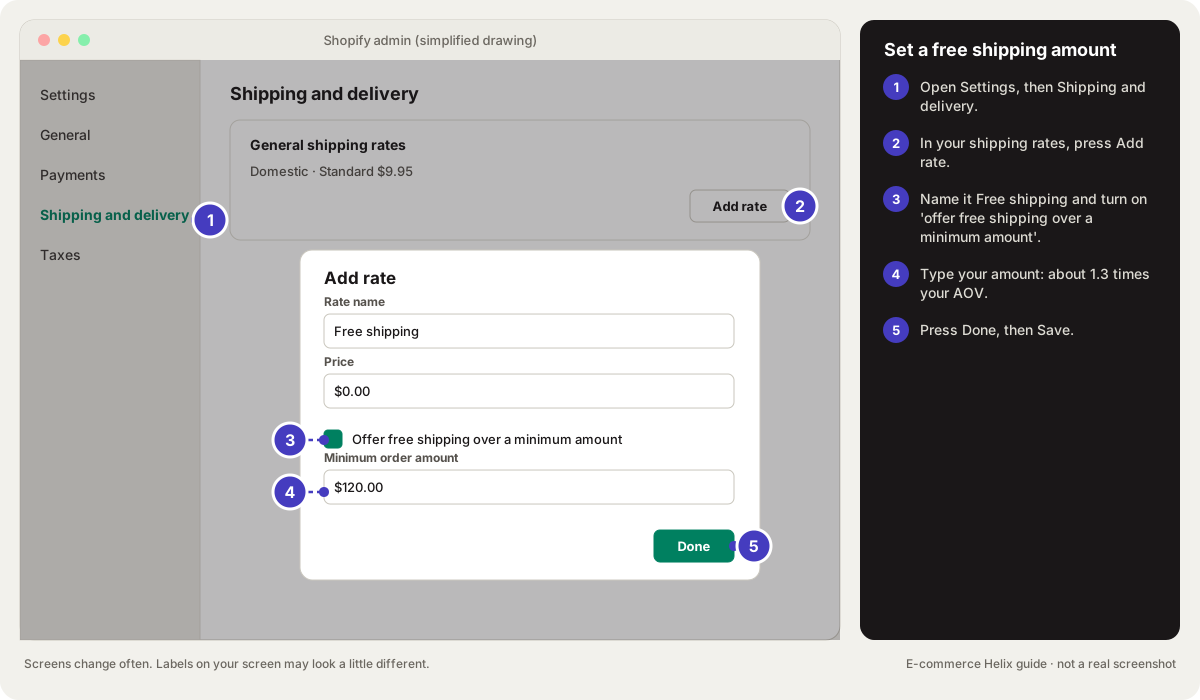
Step 1: Set your free shipping amount.

Why this matters

How you handle shipping changes how much people buy. A widely quoted rule of thumb is that about 7 in 10 online carts are abandoned. Surprise extra costs like shipping, tax and fees are one of the most common reasons shoppers give. A free shipping amount set in the right place makes many people add one more item.

Step 1 of 40 of 4 done

Set your free shipping amount.

  1. In Shopify Analytics, find your average order value (AOV).
  2. Multiply it by 1.25. That's your free shipping amount (a common rule of thumb).
  3. Open Settings, then Shipping and delivery, and set free shipping from that amount.

Expected result

A free shipping rate appears at your chosen amount.

Tips

AOV
Average order value: total sales divided by number of orders.

Good to know

Set a free shipping amount in Shopify

Drawing, not a real screenshot. Labels on your screen may look a little different. Official help: Shopify: set up shipping rates

Lesson 9.12: Promotions without destroying marginConvert

In short

Margin is the share of each sale you keep, and big store-wide discounts eat it.

Do this now

Step 1: Swap your next store-wide discount for a free gift or a bundle .

Why this matters

Margin is the share of each sale you keep, and big store-wide discounts eat it. There are better ways to give people a reason to buy.

Step 1 of 20 of 2 done

Swap your next store-wide discount for a free gift or a bundle. Or try early access for best customers, or a loyalty reward.

Expected result

Your next promotion protects margin.

Tips

Bundle
Two or more products sold together, often with a small saving.
Margin
The share of each sale you keep after product cost. A $100 sale with $40 product cost is a 60% margin.

Lesson 9.13: Special casesConvert

In short

Some stores have special needs: expensive products, preorders, video shopping, big catalogues, wholesale or overseas customers.

Do this now

Step 1: For pricey products people think about for a while, give them what they need to decide.

Why this matters

Some stores have special needs: expensive products, preorders, video shopping, big catalogues, wholesale or overseas customers. Each has a few proven fixes.

Step 1 of 50 of 5 done

For pricey products people think about for a while, give them what they need to decide.

  • A comparison table with other options.
  • Payment plans.
  • Samples, swatches or a quick call.
  • Retargeting (ads to past visitors) that runs for 30 days or more.

Expected result

Long decisions have the content they need.

Tips

Hot audience
People close to buying: they added to cart or started checkout.

Lesson 9.14: Working with developersConvert

In short

Apps and developers can speed you up or slow your store down for years.

Do this now

Step 1: Before you add any app, check its cost and how much it slows the site.

Why this matters

Apps and developers can speed you up or slow your store down for years. A few checks before you commit keep costs and speed under control.

Step 1 of 30 of 3 done

Before you add any app, check its cost and how much it slows the site. Also check its support and how hard it is to remove.

Expected result

Each new app has passed four checks.

Lesson 9.15: Category patterns from store auditsConvert

In short

Stores in the same category usually miss the same things.

Do this now

Step 1: Find your category in the table below.

Why this matters

Stores in the same category usually miss the same things. Checking your category's common gaps is a fast way to find quick wins.

Step 1 of 20 of 2 done

Find your category in the table below.

Expected result

You have the list of common gaps for your category.

Good to know

Category What is usually missing
Clothing Size guidance, fit reviews, model height and size, outfit suggestions
Kids and baby Safety proof, age guidance, gift bundles
Beauty and supplements Clear ingredients, how long until results, rules on before-and-after photos, subscriptions
Accessories and jewellery Photos that show size, gift packaging, personalisation
Home and living Dimensions, photos in a room, swatches, clear delivery info
Food What it tastes like, freshness, bundles, subscriptions
Pets Proof for specific pets, refills

Lesson 9.16: When conversion suddenly drops: a 20-minute checkConvert

In short

A conversion rate that halves overnight is almost never because shoppers changed their minds.

Do this now

Step 1: Confirm the drop is real.

Why this matters

A conversion rate that halves overnight is almost never because shoppers changed their minds. It is usually something broken, a change in who is visiting, or a tracking fault. Checking in the right order finds the cause in minutes instead of days.

Step 1 of 40 of 4 done

Confirm the drop is real. Compare orders in Shopify (not ad platform numbers) for the last 3 days with the same days last week. Check sessions too.

Expected result

You know whether orders really fell, or only reported conversions or sessions changed.

Tips

Session
One visit to your store. One person can make several visits.

Lesson 9.17: Your store gap checkConvert

In short

A gap check compares your store with what buyers expect to see.

Do this now

Step 1: Open What to fix in Helix and look at Your store check .

Why this matters

A gap check compares your store with what buyers expect to see. Then you fix the biggest gaps first instead of guessing.

Step 1 of 50 of 5 done

Open What to fix in Helix and look at Your store check.

Expected result

You see up to 5 fixes, each quoting something from your own store.

Lesson 9.18: A product-finder quizConvert

In short

When you sell many products, shoppers can freeze.

Do this now

Step 1: Write down the 3 to 5 questions you would ask a shopper in person.

Why this matters

When you sell many products, shoppers can freeze. A short quiz asks a few questions and points them to the right one. Their answers also tell you what they want, so your emails can match.

Step 1 of 60 of 6 done

Write down the 3 to 5 questions you would ask a shopper in person. For example: skin type, main worry, budget.

Expected result

A short list of questions, each with 2 to 4 answers.

Lesson 9.19: Video on product pagesConvert

In short

Photos show what a product looks like.

Do this now

Step 1: Pick your best-selling product.

Why this matters

Photos show what a product looks like. Video shows it working. A short clip of a real person using it answers questions that words cannot.

Step 1 of 50 of 5 done

Pick your best-selling product. Gather 3 short clips: someone using it, a close-up, and a customer talking about it.

Expected result

3 clips, each under 30 seconds, filmed upright on a phone.

Self-check

  1. What is the funnel you watch in store reports?
  2. Where should the free shipping amount sit?
  3. Name three alternatives to a store-wide discount.
  4. What do you check first when conversion suddenly drops?
Answers
  1. Sessions, then add to cart, then reached checkout, then purchase.
  2. A bit above your average order value (AOV), about 1.25 times as a rule of thumb.
  3. Any three of: a free gift, bundles, early access for best customers, loyalty rewards.
  4. Confirm the drop is real in Shopify orders and tracking, then test checkout and payments. Then check recent changes, stock, prices and traffic sources.

Words to know in this module

AOV
Average order value: total sales divided by number of orders.
Conversion rate
Out of every 100 visits, how many end in an order. 2% means 2 orders per 100 visits.
Above the fold
The part of a page you see before you scroll.
Free shipping threshold
The order amount where shipping becomes free, like 'Free shipping over $100'.
Theme
The design template for your Shopify store. It controls how every page looks.
Session
One visit to your store. One person can make several visits.
Funnel
The steps from seeing an ad to buying: visit, add to cart, checkout, order.
Bundle
Two or more products sold together, often with a small saving.
Landing page
The page someone lands on after clicking an ad.
Hook
The first line or first 3 seconds of an ad. Its only job is to make people stop scrolling.
Revenue
The money customers paid for orders. Helix uses net sales: after discounts and refunds, without GST or VAT. It is not what you keep.
Margin
The share of each sale you keep after product cost. A $100 sale with $40 product cost is a 60% margin.
Hot audience
People close to buying: they added to cart or started checkout.
All words to know